As the second biggest landowner in Northern Ireland, we work hard to manage our land in a way which benefits water quality and habitats as well as welcoming the public to enjoy recreation in many of these beautiful areas.
Our sustainable catchment management relies on our partnerships and co-designed projects with others: land managers, farmers, regulators, charities, environmental groups, universities and trusts.
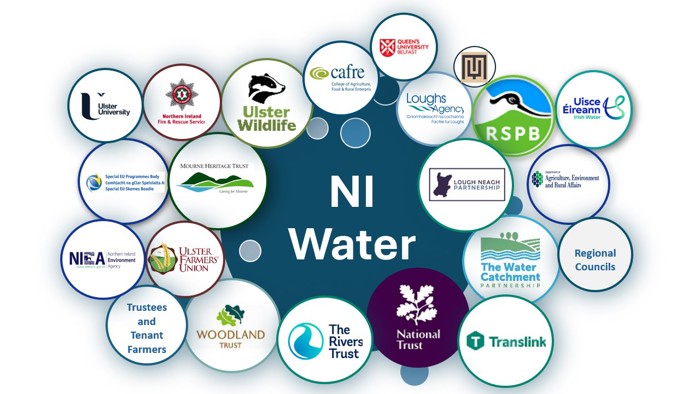
We also recognise that by working in partnership with others we can provide better value for money in our activities and achieve better joint outcomes. Our sustainable catchment work very much has partnership working at its heart.Some of the organisations we work with are shown below.
Pesticides, nutrients and sediment loss are amongst the main issues affecting raw water quality prior to the water being abstracted from rivers and lakes and treated for supply during the water treatment process.
Pesticides
Pesticides is the collective name for any substances which control pests, including weeds. The umbrella term includes herbicides, fungicides, molluscicides and insecticides.
Sometimes trace amounts of pesticides (such as the herbicide MCPA) find their way into surface waters used for drinking water supply and are difficult and expensive to remove during treatment.
What is MCPA?
MCPA is a selective herbicide specifically designed to kill weeds without harming crops and is a common active ingredient in both agricultural and domestic herbicide products. MCPA is widely used for controlling the growth of weeds like the Common Soft Rush and is the most commonly found herbicide in our raw water prior to treatment.
Once in the water it can take several weeks to break down and so NI Water frequently detects levels of MCPA in the raw water at many of our drinking water sources. We install activated carbon treatment processes in the catchments where it is an issue, to ensure removal during the water treatment process and that drinking water quality is of a high-quality standard.
What are we doing about pesticides in our raw water?
We’re proactively working to reduce MCPA in our drinking water catchments by:
Working with landowners in some of our catchment areas to try
to change land management practices and to reduce risks to our raw water and improve farm businesses.
Running free Rush Solution Without Pollution alternative weed-control methods for land owners in problem catchments (weed-wiper provision for application of glyphosate).
Being an active member of the Water Catchment Partnership (WCP), which was established in 2013 to help address significant water quality issues in Northern Ireland related to pesticides. It comprises NI Water, Ulster Farmers Union, Northern Ireland
Environment Agency, Department of Agriculture, Environment and Rural Affairs, College of Agriculture, Food and Rural Enterprise, The Voluntary Initiative, Golf Ireland, Translink and Armagh City, Banbridge and Craigavon Borough Council.
Working with the College of Agriculture, Farming and Rural Enterprise (CAFRE) to deliver rush control events which are an opportunity for farmers to learn about rush management.
meeting landowners and farming groups through evening events and agricultural shows.
Read about how you can help us keep pesticides out of waterways here.
Turbidity and Colour
Turbidity and colour (soil and organic matter) can naturally fluctuate in raw water and is very important to remove. Turbidity is the cloudiness or haziness of water caused by particles suspended within the water column. These particles can include sediment, algae, clay, and other substances and can be caused by both natural processes and human activities. High levels of colour in raw water are generally because of dissolved organic material, giving the water colour ranging from orange to brown.
What are we doing about colour and turbidity in our raw water?
Reducing colour and turbidity concentrations at source depends on where the issue is coming from. In some of our upland drinking water catchments, damage to peatlands or wildfires contributes to colour and turbidity in the raw water we collect, in other more agricultural catchments it might be arising from the erosion of soil from agricultural practices.
Peatland Degradation
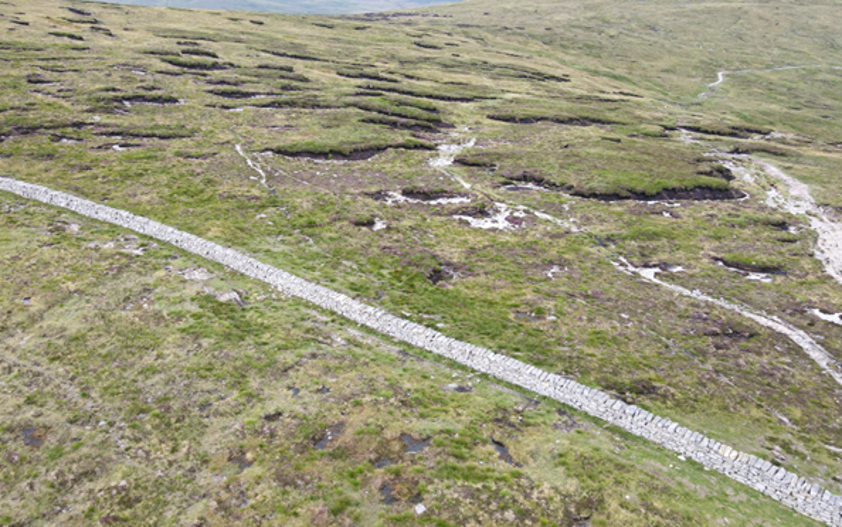
The peat in our uplands has been forming for many thousands of years but in more recent times, pressures such as acid rain from industrial emissions, draining peatland to enable grazing, overgrazing, wildfires and inappropriate burning have all resulted in a degradation of peatlands, and a decline in their biodiversity. This deterioration in the peatland not only affects their ability to filter water quality, provide flood alleviation and biodiversity service but as peatlands are important in the storage of carbon, the damage to peat causes the release of carbon into the atmosphere - contributing to greenhouse gas emissions.
We have been carrying out restoration in some of our upland peat catchments since 2014. Garron Plateau Special Area of Conservation (SAC) holds our Dungonnell drinking water catchment and is the largest area of intact blanket bog in Northern Ireland. Read about our Garron Plateau project here, and the learn about how restoration of this peatland has many other benefits here.
We also work with DAERA Forest Service on upland areas leased to them for commercial forestry.
Lough Bradan outside Drumquin, Co. Tyrone is a peatland catchment where we have worked with specialist peatland contractors and DAERA Forest Service to block forest drains and remove conifer regrowth after felling, stopping run-off of organic material into the Lough, raising the water table and holding back carbon/peat in the ground where it belongs. Read about our Lough Bradan project here.
Wildfires, peat and heathland management in the Mournes
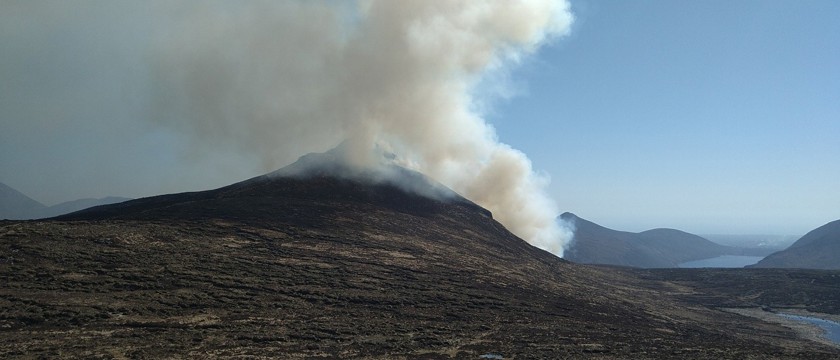
Wildfires across our catchment and particularly in the Mournes have in the past damaged habitats and adversely affected water quality. The impacts can occur during active burning when the ash and contaminants settle on streams, lakes, and water reservoirs or afterwards due to soil erosion and increased flooding. Bare areas of peat are eroded easily and can cause high levels of colour, turbidity and total and dissolved organic carbon (TOC and DOC) which gives a strong colour to the raw water colour received at the water treatment works.
NI Water works in partnership with others including Mourne Heritage Trust who carry out extensive path maintenance and repair on our behalf, and we jointly develop a practical approach to wildfire management and recovery. We want to protect the drinking water supply, protect the peat heathland and preserve the beautiful Mourne landscape for generations to come.
Since April 2023, our Team has been a member of the Forever Mournes Partnership, a dedicated group of landowners and managers (Mourne Heritage Trust, National Trust and NI Water) who formalized our commitment to work together across our collective land and interests in the Mourne Mountains in Co. Down after devastating wildfires on Slieve Donard in 2021. The Mourne mountains provide much of the drinking water for Belfast and beyond, so understanding the landscape, people and place is important to our catchment management there.
We have a vision for the future of the Mournes to be shared by the local community and all those who care about the area. To deliver the vision we will agree a long-term management plan for our public and charitable-owned lands, which everyone supports and has enough funds to ensure it can be realised. This is what Forever Mournes are working towards. For more information, please visit here.
Agricultural Erosion
Agricultural land dominates most of our drinking water catchments and we recognise that farmers and the agricultural sector are important stakeholders for us. We work with them to realise the improvements needed in our catchments. To reduce erosion, we have:
Worked with farmers through in Clay Lake catchment Keady, Co.Armagh in our Farming for Water project to drive down riparian erosion through stock-proof fencing and new mains or solar drinkers.
The planting of 55,742 native broadleaf trees along the banks of the Glenedra River, Co Londonderry in our Caugh Hill catchment in a joint initiative with the Woodland Trust and The Loughs Agency helps to reduce bankside erosion improving water quality and positively impacting habitats and aquatic species.
Nutrients
Increased levels of nutrients like nitrogen and phosphorus in the water environment can cause excess biological growth or eutrophication of our rivers and lakes. These high concentrations can speed up the growth of certain plants which disrupt natural processes and are devastating for wildlife. Nutrients in surface waters can come from both point sources (specific discharge points) and nonpoint sources (diffuse pollution dispersed over the land area).
Lough Neagh is the largest freshwater lake in the United Kingdom covering an area of 383 km2 and the rivers which flow into Lough Neagh drain about 43% of Northern Ireland. Lough Neagh supplies Northern Ireland with 46% of its drinking water for about 750,000 people. In recent years Lough Neagh has experienced blue-green algal blooms because of high levels of nutrients.
What are we doing about nutrients in our raw water?
NI Water is part of the Forever Lough Neagh Partnership, and we are committed to working with our partners to reduce nutrients entering the Lough Neagh catchment from all sources. We will be developing some nutrient reducing measures along with our partners and land managers in our catchments, subject to funding.
Externally Funded Projects
NI Water has utilised the opportunity to apply for EU funding to further our sustainable catchment management work. In the INTERREG VA programme, we successfully led a project called Source to Tap and worked in partnership with Agri-Food and Biosciences Institute (AFBI), East Border Region (EBR), The Rivers Trust (TRT), Uisce Eireann (UE) and Ulster University. Details of the work carried out in the Source to Tap project can be found here.
Can't find what you're looking for? Visit the Need our Help section