
Higher Than Normal Bill?
Is your bill higher than normal? We’re here to help.
We understand receiving a higher than normal water bill can be concerning. While there may be a simple explanation you’re already aware of, one of the most common causes is a leak on your supply.
To support you as quickly and effectively as possible, we kindly ask that you carry out a quick and easy Continuous Usage test before getting in touch. This helps us understand what’s happening and ensures we take the right next steps for you.
Let’s get started.
To guide you through the right steps, please tell us what kind of water supply you have:
1. Shut Down All Water-Using Equipment
Turn off irrigation systems, troughs, pressure washers, and any machinery or taps which use water.
Ensure automated systems (e.g. timers or float valves) are paused or disabled.
2. Notify everyone on site
Inform anyone on-site not to use water during the test period, including flushing toilets or washing equipment.
3. Locate Your Water Meter
Your meter is typically located at the boundary of your property or just outside it, possibly in a roadside chamber.
For a more accurate location of your meter, please check page two of your bill (top right)
4. Access the Meter Safely
Use a wide screwdriver or similar tool to lift the outer lid.
Remove any frost cover (e.g. polystyrene) if present.
If your meter is an AMR (Automated Meter Reading) type, it may have an additional lid which can be lifted to show the face.
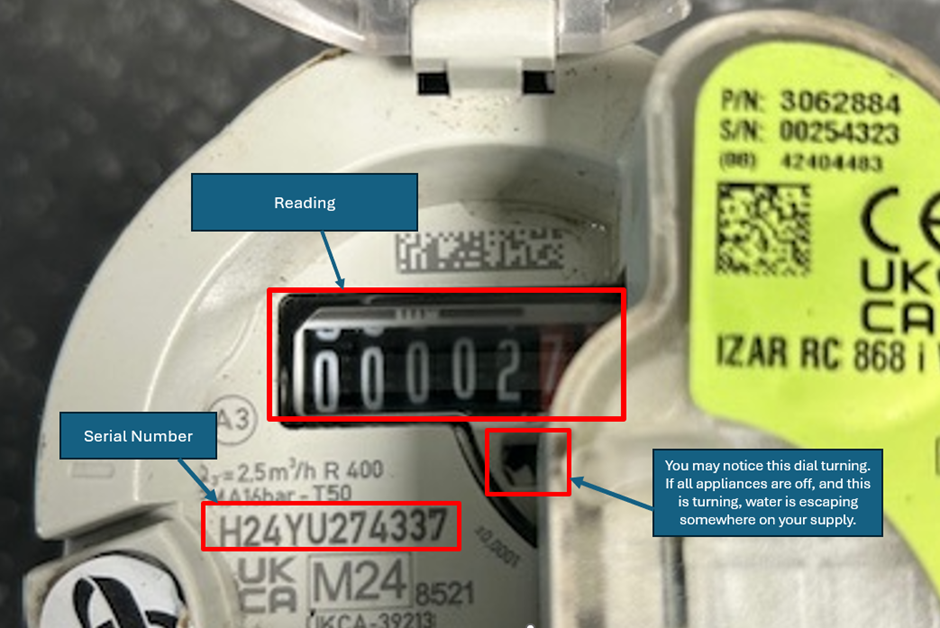
Double check the serial number on the meter matches the one listed on your bill or notification letter.
5. Take a Reading
We recommend using your phone to take a clear photo of the meter face.
Focus on the white numbers on a black background – these show usage in cubic metres (m³).
Ignore red digits or dials, which represent smaller units.
6. Wait and Re-Read
For high water users (e.g. dairy farms, large-scale irrigation, livestock operations), wait 30–60 minutes.
For lower water users (e.g. smallholdings, greenhouses), consider waiting overnight.
Take another photo of the meter after the wait period.
7. Closing the Meter lid
Please replace any frost cover (e.g. polystyrene) if one was present.
Ensure the meter lid is closed properly/completely and is not causing a trip hazard.
1. Turn Off All Water-Using Fixtures
Shut off taps, dishwashers, washing machines, water-cooled equipment, and any other appliances which use water.
Pause any automatic systems (e.g. flush sensors, cleaning cycles).
2. Inform Staff
Ask employees or anyone on-site not to use water during the test period, including flushing toilets or using kitchen/bathroom facilities.
3. Locate Your Water Meter
Your water bill will indicate the meter’s location. It’s typically found:
o In a pavement chamber outside the property
o In a kitchen or utility area (for internal meters)
4. Access the Meter
Use a wide screwdriver to lift the outer lid if the meter is external.
Remove any frost cover (e.g. polystyrene) if present.
If your meter is an AMR (Automated Meter Reading) type, it may have an additional lid which can be lifted to show the face.
5. Verify the Meter
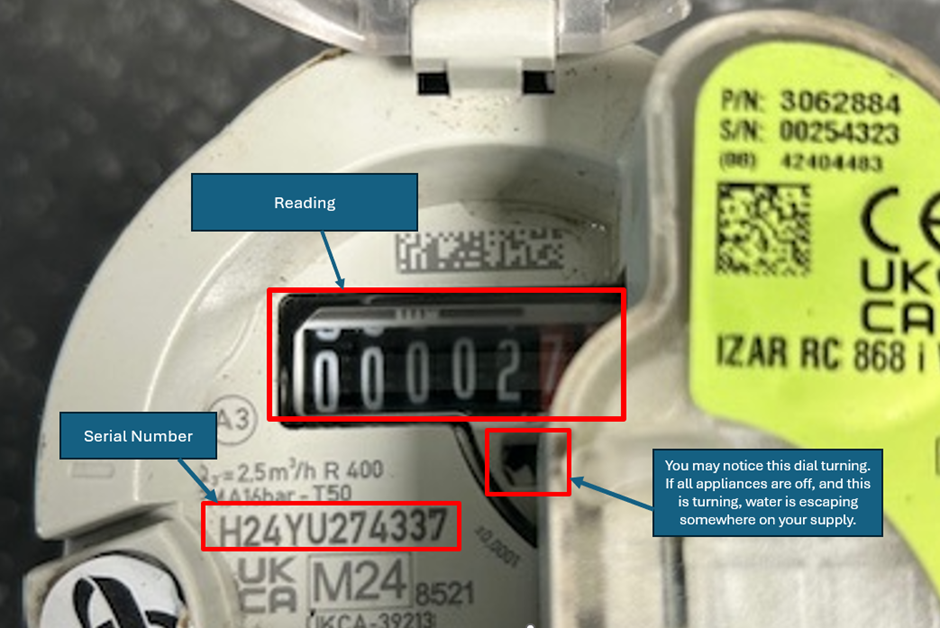
Check the serial number on the meter matches the one listed on your bill or notification letter.
6. Take a Reading
Use your phone to take a clear photo of the meter face.
Focus on the white numbers on a black background – these show usage in cubic metres (m³).
Ignore red digits or dials, which represent smaller units.
7. Wait and Re-Read
For high water users (e.g. restaurants, gyms, laundrettes), wait 30–60 minutes.
For lower water users (e.g. offices, retail shops), consider waiting overnight.
Take another photo of the meter after the wait period.
Closing the Meter lid
Please replace any frost cover (e.g. polystyrene) if one was present.
Ensure the meter lid is closed properly/completely and is not causing a hazard.
What do the results mean?
There is a difference between the two readings
This suggests water is escaping after the meter — possibly a leak within your property boundary. Please see the 'Pipework responsibility' diagram here.
You may need a plumber to investigate. Visit watersafe.org.uk or needaplumber.org for approved plumbers.
You are responsible for pipework from the meter onwards, and payment is required for all water which passes through it. Please refer to the Further Support & Leakage Allowance section below for additional guidance and support.
The two readings are the same
This indicates there is no free-flowing leak at this point in time. Since your last bill have you:
- Had leaking taps, toilets, or pipes?
- Installed or replaced water-using appliances?
- Done any building or DIY work?
- Used more water for livestock or troughs?
- Had more people on-site?
- Is your water supply shared with another user?
If you cannot think of a reason for using more water than usual, then this unexplained increase in usage may require further investigation. Please contact us to discuss the next steps.
If you need to contact us, please ensure you have your two meter readings (with date and time) and your customer reference number (found at the top of your bill) ready as our agent will request these.
Further Support & Leakage Allowance
In some cases, depending on where the leak occurred, what your supply serves, and how quickly it was resolved, your business may be eligible for a leakage allowance to help reduce your high bill.
Once the leak is repaired, please complete our Leakage Allowance Application to allow us to review your account. You can fill it in via the form link below or download and email it to us – whatever is easiest for you.
Please Read Before You Complete The Form
Ensure all leaks on private pipework are fully repaired before submitting this form.
Take two readings from your water meter at least one week apart, after all repairs have been completed. This will help us confirm your consumption has returned to expected levels. We cannot proceed unless we are sure there is no leakage present on your supply.
A diagram of your pipework is required as part of this application. Simply sketch a map showing the pipework layout, direction of the flow of water, location of the leak, water meter and all domestic and non-domestic elements. An example diagram can be viewed here.
Take a photo of the sketch and upload it with your application.
We require a valid email address so NI Water can respond to your application. Please also consider entering your mobile phone number to allow us to reach you easier if more information is required.
Once your completed form is submitted, NI Water will respond within 5 working days. If you express any dissatisfaction with NI Water on the form, your application may be treated as a complaint. If a complaint is detected, NI Water will respond within 10 working days to allow for further investigation.
Leakage allowance applications must be submitted truthfully and at your earliest convenience. Delays and incorrect information may hinder or prevent a leakage allowance.
LEAK ALLOWANCE APPLICATION